
 Telephone
 Email
Email
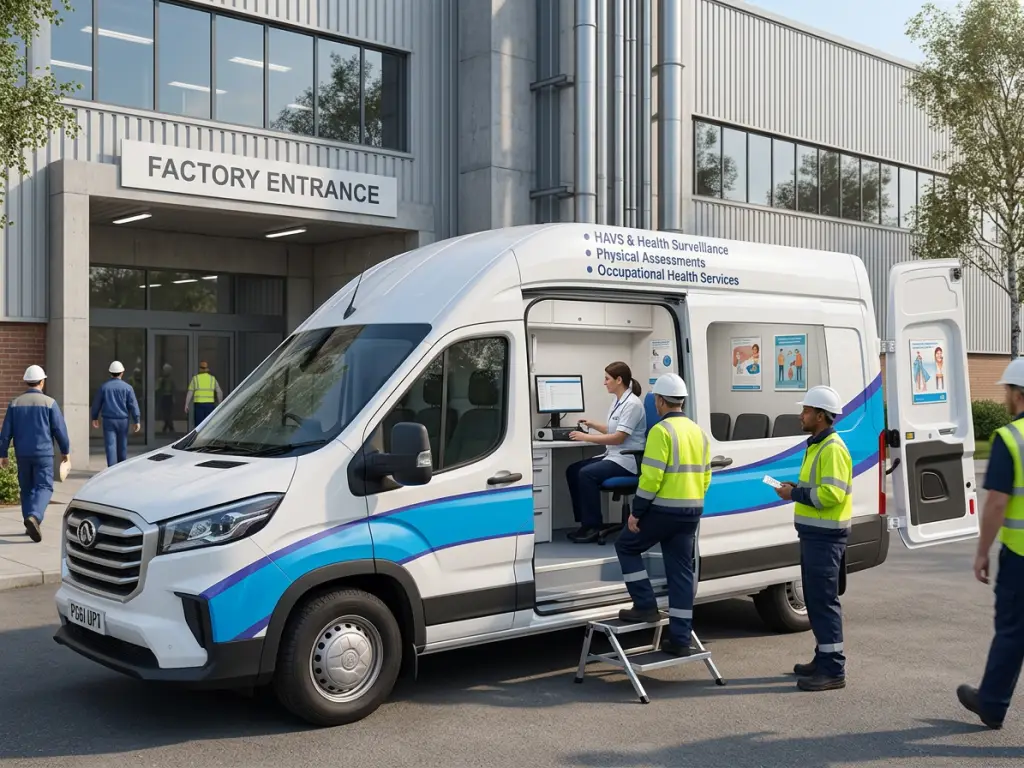
Mobile health surveillance units bring HAVS testing, audiometric checks, spirometry and other statutory assessments directly to construction, manufacturing and logistics sites nationwide, delivering workplace health surveillance benefits with minimal disruption. Clarity Occupational Health Ltd’s SEQOHS-accredited fleet reduces employee downtime, minimises production disruption, and supports HSE compliance across multi-site operations without requiring staff to travel to external clinics.
Mobile Medical Units (MMUs) bring HAVS testing, audiometric checks, spirometry and other statutory assessments directly to construction, manufacturing and logistics sites, removing the need for staff to travel off-site.
Onsite delivery reduces employee downtime and lost production hours by cutting travel time and minimising missed or rescheduled appointments.
Clarity’s SEQOHS-accredited, ISO-certified mobile fleet gives HSE managers and HR directors a defensible, auditable compliance record across multi-site operations.
Mobile delivery models are planned around a workforce’s locations and shift patterns, supporting single-site catch-up clinics through to recurring nationwide programmes.
Faster onsite access to health data supports earlier intervention, helping reduce downstream absence and claims risk for dispersed or shift-based teams.
Value comes down to time saved and compliance secured without disrupting production. Mobile medical units bring a professional, private occupational health clinic directly to the workplace, so staff never need to travel off-site for statutory checks. For HSE managers juggling shift patterns across multiple sites, that alone removes a persistent scheduling headache.
Off-site appointments create real costs that rarely show up on a budget line. Travel time, lost production hours and last-minute rescheduling all chip away at operational efficiency when staff are spread across busy sites or remote locations. Clarity’s approach to mobile medical units health surveillance eliminates much of that friction by bringing clinical capability to the door.
A Mobile Medical Unit, or MMU, is a purpose-built clinical vehicle. It allows occupational health assessments to happen at or close to the workplace, rather than at a distant clinic.
Attendance improves when the clinic comes to the workforce instead of the other way round. Delivering onsite occupational health surveillance, role-specific medicals and other assessments on site makes it easier for employees to attend and easier for managers to keep programmes on schedule.
The practical gains include:
Reduced travel time and lost shift hours
Fewer missed or rescheduled appointments
Simpler tracking toward HSE health surveillance compliance
Consistent delivery across dispersed sites
Those combined efficiencies are what make mobile health screening units UK wide a genuinely sound operational investment, not just a convenience.
Onsite health checks close the gap between legal duty and daily practice. Employers who bring surveillance directly to the workplace catch problems early, before they become HSE enforcement issues or long-term claims. Clarity Occupational Health Ltd delivers onsite occupational health surveillance through SEQOHS-accredited. ISO-certified programmes, giving HSE managers and HR directors clear governance behind every assessment. Operating from Stockport, Greater Manchester, Clarity supports compliance programmes across multi-site organisations nationwide, not just within one region.
Accreditation matters because it converts surveillance from a box-ticking exercise into a defensible compliance record. Independently verified governance means audit trails, consistent methodology, and reporting that stands up to scrutiny.
Skin surveillance directly supports HSE health surveillance compliance for employers handling hazardous substances. Whether an organisation is responding to a fresh COSHH assessment, reviewing an existing programme, or building monitoring from scratch, structured skin checks clarify which roles actually need surveillance and how to run it without disrupting operations.
Planned checks are designed to catch early warning signs, including:
Irritant contact dermatitis
Allergic contact dermatitis
Eczema
Chemical irritation
Catching these conditions early prevents escalation into long-term absence or compensation claims. For construction, manufacturing, and industrial employers handling oils, resins, cement, or metalworking fluids, this proactive approach turns a legal obligation into a practical, manageable programme rather than a reactive scramble after an inspection.
Construction, logistics, manufacturing and multi-site industrial employers see the strongest return from mobile health screening units UK providers deploy. Dispersed teams, shift patterns and site access restrictions make traditional clinic visits costly and disruptive. Mobile medical units health surveillance removes that friction by bringing testing to the workforce rather than the other way round.
Onsite occupational health surveillance works best when delivery models flex around the organisation, not the other way round. Providers plan mobile delivery around a client’s workforce, site locations and operational rhythm, whether that means a single catch-up clinic, coordinated support across several sites, or a recurring nationwide programme.
Occupational health providers serve a wide range of sectors, spanning construction and logistics through to healthcare and office-based environments. Each sector carries different exposure risks and shift structures, which is why flexible mobile delivery matters more than a one-size-fits-all clinic model.
Mobile approaches give providers faster access to the information needed to improve health outcomes and manage costs. Faster data flow supports earlier intervention, which reduces downstream absence and claims risk for employers managing large or dispersed teams.
Organisations best suited to mobile screening typically share these traits:
Multiple sites or regional depots requiring coordinated coverage
Shift-based or safety-critical roles where downtime is costly
Workforces too dispersed for practical clinic-based attendance
Mobile health surveillance brings HAVS testing, audiometric checks and spirometry directly to construction, manufacturing and logistics sites, reducing employee downtime, minimising production disruption, and supporting HSE compliance across multi-site operations without off-site travel.
A Mobile Medical Unit is a purpose-built clinical vehicle that delivers occupational health assessments at or near the workplace, removing the need for staff to travel to a distant clinic for statutory checks.
Onsite delivery catches problems early, before they escalate into HSE enforcement issues or claims. Clarity’s SEQOHS-accredited and ISO-certified programmes give HSE managers and HR directors clear, defensible governance behind every assessment.
In closing, mobile health surveillance delivers genuine operational advantage by bringing clinical expertise directly to your workforce, eliminating travel friction and maintaining consistent compliance across multiple sites. This flexible, on-site approach protects employee wellbeing whilst reducing absence and productivity loss—outcomes that strengthen both your duty of care and your bottom line. Clarity’s nationwide mobile capability ensures your organisation receives the same rigorous, evidence-based assessment regardless of location or shift pattern.
We use cookies to improve your experience on our site. By using our site, you consent to cookies.
Manage your cookie preferences below:
Essential cookies enable basic functions and are necessary for the proper function of the website.
You can find more information in our Cookie Policy and .
Tell us about your workforce, sites and requirements. We will call you to discuss a practical occupational health solution and the most suitable delivery options.
We use cookies to improve your experience on this website. You may choose which types of cookies to allow and change your preferences at any time. Disabling cookies may impact your experience on this website. You can learn more by viewing our Cookie Policy.