
 Telephone
 Email
Email
If employees in your organisation are exposed to noise, vibration, dust, fumes, chemicals, biological agents or other workplace hazards, we can help you put the right health surveillance in place.
Clarity provides practical, risk-based health surveillance programmes for employers across the UK. Whether you are reviewing an existing programme, responding to a new risk assessment or starting from scratch, we will guide you through the options and help you create an approach that works for your people, sites and day-to-day operations.
Health surveillance is a planned programme of repeated health checks for employees whose work may expose them to hazards known to cause ill health. This can include exposure to noise, vibration, respiratory sensitisers, skin irritants and other substances hazardous to health.
It works alongside your risk assessments and control measures. While those controls aim to reduce exposure, health surveillance can help you check whether they are working in practice and identify early signs of work-related ill health.
This gives you clearer information to support timely action, protect employees and keep your workplace health arrangements under review.
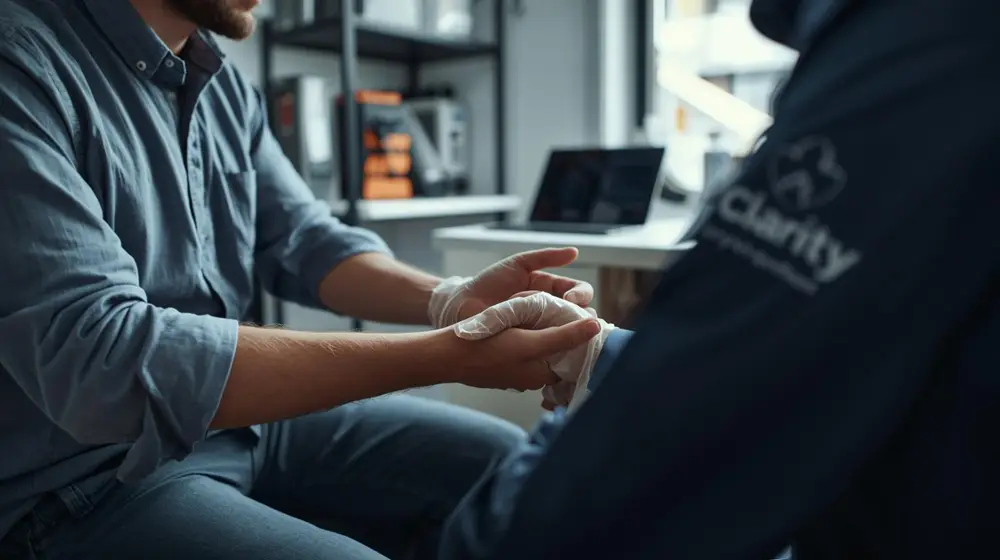
Every organisation has different risks, roles, sites and working patterns. We take the time to understand how your workplace operates, then help you build a health surveillance programme that is proportionate, practical and straightforward to manage.
We use your risk assessments and exposure information to help identify which employees may need health surveillance, the health risks that should be monitored and the most appropriate level of assessment.If you are unsure what is required, we can work through the relevant information with you and help clarify the practical next steps.
We know it can be difficult to release employees from busy sites or shift-based roles. Health surveillance can be delivered through on-site clinics, mobile medical units and clinic-network appointments, helping you reach the right people while keeping travel, downtime and disruption to a minimum.We will help you choose the delivery approach that best suits your workforce and locations
You receive clear employee outcomes, appropriate recommendations and management information to support follow-up action. Where relevant, trend data can help you understand where controls appear to be working well and where further review may be helpful.Our aim is to give you useful information that is easy to act on, not reporting that creates more work for your team.
Health surveillance can sit alongside management referrals, safety-critical medicals and other occupational health services. Where that is helpful, we can bring these services together into one clearer, more joined-up approach to managing workforce health risks.
The right programme depends on the hazards identified in your risk assessments, the roles people carry out and the level of exposure involved. Your programme may include one service or a combination of the following:
Noise surveillance – Hearing checks and audiometry for employees exposed to hazardous workplace noise.
Respiratory surveillance and spirometry – Questionnaires and lung-function testing where people may be exposed to respiratory sensitisers, dusts, fumes or other airborne substances.
HAVS surveillance – Structured assessments for employees who use vibrating tools, machinery or equipment.
Skin surveillance – Checks for employees exposed to wet work, irritants or sensitisers that may lead to dermatitis or other skin conditions.
Biological monitoring – Where appropriate, monitoring that helps assess how effectively controls are preventing uptake of particular substances.
We will help you understand which elements are appropriate for your workforce, rather than applying a standard package that does not reflect your actual risks.
Health surveillance may be needed when a risk assessment identifies exposure to a hazard that is linked to a known disease or adverse health effect, where there is a reasonable likelihood of that effect occurring in the conditions of work, and where valid methods are available to identify early signs.
This may include exposure to:
Noise and vibration.
Respiratory sensitisers and irritants.
Substances that can cause dermatitis or other skin conditions.
Certain metals, solvents and other agents with systemic effects.
If you are reviewing your requirements, we can help you interpret your risk assessments and understand where health surveillance may be appropriate.


A well-planned health surveillance programme gives employers useful insight into how work may be affecting employees’ health. It can help you:
Identify possible work-related ill health at an early stage, so appropriate support and action can be considered.
Check whether control measures are working as intended and highlight potential gaps for review.
Use workforce health information to review and improve risk assessments.
Give employees a clear route to raise concerns about how work may be affecting them.
Reinforce safe-working practices, training and the correct use of protective equipment.
Health surveillance does not replace the need to manage risk at source. It provides important feedback on whether your existing controls are protecting people as intended.
Health surveillance can feel complex, particularly when you are balancing workplace risks, compliance responsibilities, operational pressures and employee wellbeing. Our role is to make the process clearer and more manageable.
We listen first — We take time to understand your workplace risks, roles, workforce and operational priorities.
We provide clear guidance — We help you understand what may be appropriate, without making the process more complicated than it needs to be.
We design practical delivery — We use on-site, mobile and clinic-based options to help make attendance manageable across your workforce.
We communicate clearly — We keep planning, delivery and reporting straightforward, so you know what is happening and what action may be needed.
We work alongside your team — We collaborate with health and safety, HR, occupational hygiene and line-management teams to support a more joined-up approach.

Whether you are introducing health surveillance for the first time, reviewing an existing programme or responding to new workplace risks, our team is ready to help.
We will take the time to understand your workforce, hazards, locations and practical requirements, then help you put a programme in place that protects employees and works around the way your organisation operates.
Health surveillance is a planned programme of repeated health checks and questionnaires for employees exposed to workplace health risks. It is designed to identify early signs of work-related ill health, helping employers protect their people and meet relevant responsibilities.
Health surveillance may be needed where risk assessments identify ongoing exposure to hazards such as noise, vibration, respiratory sensitisers, skin irritants or certain chemicals, and where that exposure could potentially cause ill health even when controls are in place.
If you are not sure whether it applies to your workforce, we can help you review the information and understand the appropriate next steps.
This depends on the risks present in your workplace. A programme may include audiometry for hearing, spirometry for lung function, HAVS assessments, skin checks, vision screening, urine or blood tests, and questionnaires relating to symptoms and exposure.
We will recommend the elements that are relevant to your risk assessment and workforce roles.
The appropriate frequency depends on the type and level of risk, the employees involved and any clinical findings. Many programmes are delivered annually, although different intervals may be appropriate in some circumstances.
We can advise on a suitable schedule based on your risk assessment and operational requirements.
No. Health surveillance focuses on identifying work-related ill health linked to specific workplace exposures. General health screening and health-promotion programmes cover broader health topics that may not be caused by work.
Yes. We can provide health surveillance through on-site clinics, mobile medical units and local clinic appointments. We will work with you to choose an approach that suits your sites, shift patterns and workforce availability.
Employers receive appropriate outcome summaries and recommendations, along with management reporting and trend information where relevant. This helps you plan follow-up action, review controls and maintain a clear record of your programme.
Employees’ medical information remains confidential; managers receive only the information needed to manage workplace action appropriately.
Yes. Health surveillance data is handled under clinical governance and data-protection standards. Medical information is kept confidential and securely stored, while employers receive appropriate outcome summaries and recommendations rather than full clinical records.
We use cookies to improve your experience on this website. You may choose which types of cookies to allow and change your preferences at any time. Disabling cookies may impact your experience on this website. You can learn more by viewing our Cookie Policy.